Song Data
Replace fixed spawning with authored song data. Notes appear when the song says they should, not on a timer.
What You’re Building
Notes spawn on a fixed timer. Track 1, track 2, track 3, repeat. That’s predictable — not musical. Real rhythm games have authored patterns.
By the end of this unit, you’ll have:
- Song data that specifies exactly when each note appears
- Delta timing — each note says “wait N frames after the previous note”
- Track assignment from data, not rotation
- Song completion detection
- The same engine playing any song you write
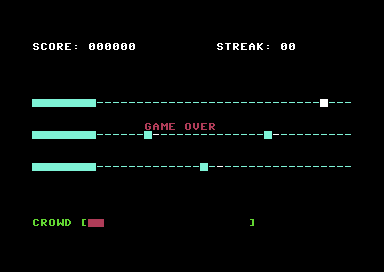
The Power of Data-Driven Design
Here’s the key insight: the game engine doesn’t change — only the data does.
The same code that plays a simple test pattern can play a complex musical piece. The code doesn’t know or care what song it’s playing. It just reads data and spawns notes.
This is data-driven design. It’s how real games work.
Song Data Format
Each note is two bytes: delta time and track.
; Song data: pairs of (delta_frames, track)
; delta = frames to wait before spawning this note
; track = 0 (top/X), 1 (middle/C), 2 (bottom/V)
; End marker: 0, 0

song_data:
            !byte 60, 1         ; After 60 frames, note on middle track
            !byte 40, 1         ; After 40 more frames, middle again
            !byte 40, 0         ; After 40 more frames, top track
            !byte 40, 2         ; After 40 more frames, bottom track
            ; ... more notes ...
            !byte 0, 0          ; End marker
Why delta timing instead of absolute timestamps? Absolute timestamps overflow a byte quickly — 255 frames is only about 5 seconds at 50fps. Delta timing allows songs of any length.
The Song Pointer
We need to track where we are in the song:
; Zero page pointer for indirect addressing
song_ptr        = $fd       ; 2 bytes: $fd-$fe

; Variables
next_note_timer: !byte $00
song_playing:   !byte $00
The pointer must be in zero page for indirect addressing to work. That’s why we use $fd (and $fe for the high byte), not a regular variable location.
Initialising the Song
init_song:
            ; Set song pointer to start of song data
            lda #<song_data
            sta song_ptr
            lda #>song_data
            sta song_ptr + 1

            ; Read first delta time
            ldy #$00
            lda (song_ptr),y
            sta next_note_timer

            ; Song is playing
            lda #$01
            sta song_playing

            rts
The < and > operators extract the low and high bytes of an address. #<song_data gives the low byte of wherever song_data lives in memory.
Reading Song Data
Every frame, we check if it’s time for the next note:
check_song:
            lda song_playing
            beq cs_done                 ; Song already ended

            dec next_note_timer
            bne cs_done                 ; Not time yet

            ; Time for next note - spawn it
            ldy #$01                    ; Track is at offset 1
            lda (song_ptr),y
            jsr spawn_note_on_track

            ; Advance pointer by 2 bytes
            clc
            lda song_ptr
            adc #$02
            sta song_ptr
            bcc cs_no_carry
            inc song_ptr + 1
cs_no_carry:

            ; Read next delta time
            ldy #$00
            lda (song_ptr),y
            beq cs_end_of_song          ; 0 = end marker
            sta next_note_timer
cs_done:
            rts

cs_end_of_song:
            lda #$00
            sta song_playing
            rts
This replaces the fixed spawn timer entirely. Notes appear exactly when the song data says.
Indirect Addressing
The instruction lda (song_ptr),y is indirect indexed addressing. It:
- Reads the 16-bit address from
song_ptr(actually from$fdand$fe) - Adds Y to that address
- Loads the byte from the resulting address
So if song_ptr contains $1000 and Y is 1, it loads from $1001.
This is how we read sequential data from anywhere in memory using a pointer we can advance.
Spawn on Specific Track
Instead of rotating through tracks, we spawn on the track specified by the song:
spawn_note_on_track:
            sta spawn_track_temp

            ; Find free slot
            ldx #$00
snot_find:
            lda note_x,x
            cmp #NOTE_INACTIVE
            beq snot_found
            inx
            cpx #MAX_NOTES
            bne snot_find
            rts                         ; No free slot

snot_found:
            lda #NOTE_START_X
            sta note_x,x

            ; Assign track from parameter
            lda spawn_track_temp
            sta note_track,x

            jsr draw_note
            rts
The track comes from the song data, stored in A when we call this routine.
Song Completion
When we read a delta of 0, the song has ended. But notes might still be on screen:
check_notes_remaining:
            ldx #$00
cnr_loop:
            lda note_x,x
            cmp #NOTE_INACTIVE
            bne cnr_found               ; Still have notes
            inx
            cpx #MAX_NOTES
            bne cnr_loop
            ; No notes left - song complete!
            jsr trigger_song_complete
cnr_found:
            rts
We check after moving notes each frame. When the song has ended AND all notes are cleared, we show the completion message.
A Real Pattern
The song in this unit has structure:
song_data:
            ; Intro - single notes, slow
            !byte 60, 1         ; Middle track (C)
            !byte 40, 1         ; Middle again
            !byte 40, 0         ; Top track (X)
            !byte 40, 2         ; Bottom track (V)

            ; Build up - alternating pattern
            !byte 30, 1         ; C
            !byte 30, 0         ; X
            !byte 30, 1         ; C
            !byte 30, 2         ; V
            ; ... repeats ...

            ; Faster section
            !byte 20, 0         ; X
            !byte 20, 1         ; C
            !byte 20, 2         ; V
            ; ... continues ...

            ; Chord hits (notes close together)
            !byte 40, 0         ; X
            !byte 5, 1          ; C (almost simultaneous)
            !byte 5, 2          ; V (chord!)

            ; End marker
            !byte 0, 0
The “chord” moments — notes spawning 5 frames apart — arrive almost simultaneously, requiring you to hit all three keys together. That’s impossible with fixed rotation.
What You’ve Built
Run it. Watch the pattern unfold. It’s not random — it’s authored. The intro eases you in, the middle section builds intensity, and the chord hits demand precision.
You now have:
- Data-driven spawning — Song data controls everything
- Indirect addressing — Reading sequential data through a pointer
- Song structure — Intro, build-up, intensity, resolution
- Completion state — The song can end
What You’ve Learnt
- Delta timing — Relative timestamps that don’t overflow
- Zero page pointers — Required for indirect addressing
- Indirect indexed addressing —
lda (ptr),yfor reading data through pointers - Data-driven design — Same code, different data, different experience
Next Unit
The engine is complete. Three tracks, song data, scoring, crowd reactions. But one song isn’t a game.
In Unit 8, we polish the full experience — the performance loop that makes you want to play again.