SID Symphony
Build a rhythm game that makes the legendary SID chip sing. Press keys in time with scrolling notes, rack up combos, and watch the crowd go wild.
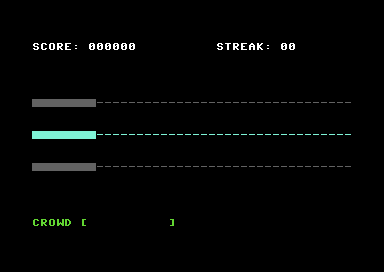
What You’re Building
A rhythm game. Notes scroll across the screen. You hit keys in time. The SID chip sings. The crowd reacts. Simple to understand, satisfying to play, and surprisingly deep to build.
Think Guitar Hero on a machine from 1982. Three tracks, three keys, three voices of the SID chip working together to create music that responds to your performance.
Why This Game?
Every C64 game needs to do three things well: put things on screen, respond to input, and make noise. SID Symphony teaches all three from the first unit.
But more than that — this game is fun. Not fun because you’re learning, fun because rhythm games are fun. You’ll want to play what you build, and that makes you want to build more.
What You’ll Learn
By the end of this game, you’ll understand:
- Screen layout — Building game UI with character graphics and colour RAM
- Animation — Moving objects smoothly across the screen
- Input handling — Reading the keyboard matrix for precise timing
- SID fundamentals — Frequencies, waveforms, ADSR envelopes, gates
- Collision detection — Knowing when a note hits the target zone
- Scoring systems — Tracking hits, misses, combos, and streaks
- Game state — Managing what’s happening and what should happen next
- Data-driven design — Storing songs as data, not code
Prerequisites
This is Game 1. No prerequisites — just enthusiasm and a willingness to type code into an emulator.
You’ll need an emulator (VICE) and an assembler (ACME). If you haven’t set these up yet, see Getting Started.
If you’ve never touched assembly before, don’t worry. Each unit explains what you need to know, when you need to know it.
Time Investment
Each unit takes 60-90 minutes. The full game is 16 units, so roughly 16-24 hours total.
But here’s the thing: every unit produces something that works. You won’t spend hours building toward a distant payoff. By the end of Unit 1, you’ll have a screen that looks like a game and a key that makes the SID sing.
Ready?
The stage is set. The SID is waiting. Let’s make some noise.